The refractive index increment is strongly dependent on the properties of the sample system, in that it depends not only on the material of the "particle" but also on the dispersant or "solvent". The refractive index increment is an indication of the contrast, and describes how much the refractive index changes when the concentration is changed.
In light scattering, dñ/dc is a component of the optical constant (K) in the Rayleigh expression used for small molecule absolute molecular weight (M) measurements, where Rq is the Rayleigh ratio of scattered to incident light intensity, C is the sample concentration, ë is the wavelength, NA is Avogadro’s constant, and ño is the solvent refractive index.
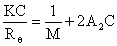
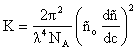
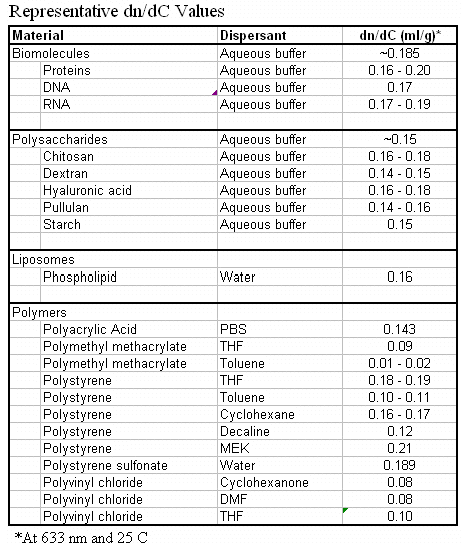
Knowledge of the specific refractive index increment is therefore required and important since the scattering intensity is dependent on the square of dñ/dc. Further complexity is added with the knowledge that the refractive index increment is also wavelength and temperature dependent. Representative values for a collection of analyte-solvent pairs are given in the table below. A more exhaustive collection of values can be found in:
Theisen, A.; Johann, C.; Deacon, M.P.; Harding, S.E. "Refractive Increment Data-Book for Polymer and Biomolecular Scientists", Nottingham University Press, Nottingham UK, 2000. ISBN: 1-897676-29-8
For additional questions or information regarding Malvern Instruments complete line of particle and materials characterization products, visit us at www.malvern.com.